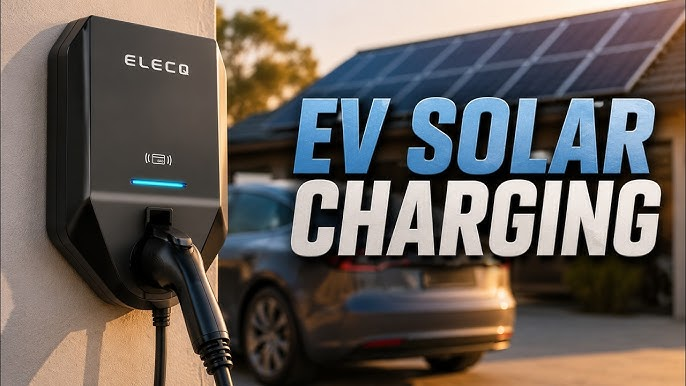
A fast charger sounds like the obvious upgrade until the car spends most of the day parked while the roof is making power. For a solar home, the better question is not only how quickly the charger can fill the battery. It is whether the charger can work with the house, the panels, and the electricity plan without turning every evening into a new peak load.
That question is getting less niche. The International Energy Agency reported that electric car sales rose to 21 million units in 2025, with one in four cars sold globally being electric. More EVs means more garages need equipment that behaves less like a simple wall outlet and more like part of the home energy system.
Start with the charging pattern, not the product page
Level 2 charging usually means AC charging through a 240-volt circuit in a home. The U.S. Department of Energy’s Alternative Fuels Data Center says Level 2 equipment commonly uses 240 V residential service or 208 V commercial service. That is enough for most overnight charging, but solar homes have a different constraint: the cheap energy often shows up in the middle of the day.
A driver who plugs in at 6 p.m. may miss the best solar window and charge during the local utility’s busiest period. A driver who works from home, has flexible charging times, or owns a second vehicle may be able to use more of the roof’s midday output. In that situation, a charger that can coordinate with solar surplus can matter more than squeezing out the last bit of charging speed.
What a solar-aware charger should handle
Solar surplus is the electricity left after the home has served its own loads. On a mild weekday, that might be enough to add meaningful range. On a cloudy weekend with the heat pump running, it may disappear. The charger does not need to guess perfectly, but it should be able to respond to changing household demand.
For homeowners comparing hardware, it helps to look at the broader smart home EV charging options rather than treating the charger as a standalone box. A simple charger may be fine for a driver on a flat electricity rate. A solar household, especially one planning battery storage or backup power later, benefits from equipment that can grow into a managed energy setup.
· Can charging be scheduled around a time-of-use plan?
· Can it prioritize solar production when the car is home?
· Does it support the connector the current or next vehicle will use?
· Can it fit into a larger home energy system without another app for every device?
Speed still matters, but only up to a point
A commuter adding 30 or 40 miles per day rarely needs to refill an entire battery every night. A large battery, a long commute, or a shared family vehicle changes the math. The best setup is the one that restores the miles needed before the next drive while avoiding expensive electrical upgrades that do not solve a real problem.
There is also a quiet future-proofing issue. The home that starts with one EV may later add a second vehicle, a heat pump, or a battery. The charger should not be the part that forces the whole system into a corner. Sigenergy’s SigenStor system is worth reviewing when the goal is to connect charging with solar and home energy management instead of just adding another load to the panel.
A good solar-home charging plan is boring in the best way: the car is ready, the bill is predictable, and the roof’s output gets used before it gets wasted.