Choosing an air duct cleaning provider is not always a straightforward decision. A clean duct system can help a home feel fresher, but the service varies widely in quality, scope, and cost. Some providers offer thorough inspections and careful cleaning methods, while others promote low prices without explaining what the service actually includes.
For Boston homeowners, finding a reliable air duct cleaning company Boston is important because heating and cooling systems are used for much of the year and indoor air quality can affect comfort and health. This guide explains how to compare companies, verify credentials, understand estimates, recognize warning signs, and select a provider based on evidence rather than sales promises.
1. Check the Company’s Credentials and Industry Qualifications
A professional air duct cleaning company should be able to explain its qualifications and provide relevant documentation when requested.
One useful starting point is the National Air Duct Cleaners Association (NADCA), an industry organization that publishes standards for HVAC system inspection, cleaning, and restoration.
NADCA membership can be a useful indicator of a company’s commitment to industry practices. NADCA member companies must have at least one employee who maintains its Air Systems Cleaning Specialist (ASCS) certification, and members agree to follow the association’s standards and code of ethics.
However, consumers should verify membership rather than relying solely on a logo displayed on a website.
Before hiring a contractor, ask:
- Does the company have verifiable NADCA membership or appropriately trained personnel?
- Can it provide proof of relevant certifications?
- Does it carry general liability insurance?
- Are workers covered by the applicable insurance requirements?
- Does the proposed work require any specific license or permit?
- Who will supervise and perform the cleaning?
Not every air duct cleaning service requires the same licenses, so confirm the applicable requirements for the work being proposed in Massachusetts.
An air duct cleaning company Boston homeowners hire should be willing to answer these questions without making the verification process difficult.
2. Inspect Before You Clean: When Duct Cleaning Is Actually Needed
A reliable contractor should not automatically recommend cleaning every duct system without examining its condition.
The EPA identifies substantial mold growth, vermin infestation, and significant deposits of dust or debris as situations in which cleaning may be appropriate. Visible contamination should be evaluated in context, particularly when moisture or another underlying problem may be involved.
An inspection helps establish whether cleaning is justified and which components need attention.
Depending on the system, the contractor may inspect accessible supply and return ducts, registers, grilles, air-handling components, and areas where moisture or debris is visible.
The technician should explain the findings in understandable terms. If mold is suspected, ask what was observed and whether additional assessment is appropriate. A dark deposit is not automatically mold, and visual inspection alone cannot reliably identify every type of biological contamination.
Be cautious if a salesperson insists that your entire system requires immediate cleaning but cannot show you the evidence.
A trustworthy assessment should connect the observed condition to the recommended service.
3. Compare Written Estimates and Understand the Total Price
Price is important, but the lowest advertised figure does not necessarily represent the lowest final cost.
Some advertisements quote a starting price that covers only a limited portion of the system. Additional charges may apply for extra vents, multiple HVAC systems, difficult access, or optional treatments.
A written estimate should clearly identify the following:
- The number of HVAC systems included.
- The supply and return ductwork covered.
- Whether registers, grilles, and accessible system components are included.
- The cleaning equipment and methods to be used.
- Any additional charges for access, extra components, or repairs.
- Whether chemical treatments are proposed and why.
- The total price and the circumstances that could change it.
The following table can help you evaluate competing proposals.
| Evaluation factor | What a reliable provider should offer | Warning sign |
|---|---|---|
| Initial inspection | Explains visible contamination and the need for cleaning | Recommends cleaning without assessing the system |
| Written quotation | Lists the work included and the total expected price | Provides only a low starting price |
| Cleaning scope | Identifies the ducts and components covered | Uses vague phrases such as “whole-house cleaning” without details |
| Equipment and containment | Explains how debris will be collected and dust release controlled | Cannot explain how contamination will be contained |
| Credentials | Provides verifiable membership, training, and insurance details where applicable | Uses certification claims that cannot be verified |
| Chemical treatments | Explains the specific reason for any proposed treatment | Claims sanitization is mandatory for every system |
| Completion checks | Allows a visual review of cleaned components | Refuses to show the work performed |
| Customer service | Answers questions and documents changes to the agreed scope | Pressures the customer to approve unexpected charges |
A clear quotation makes it easier to compare the full services offered rather than relying on headline prices.
4. Understand the Cleaning Method and Equipment
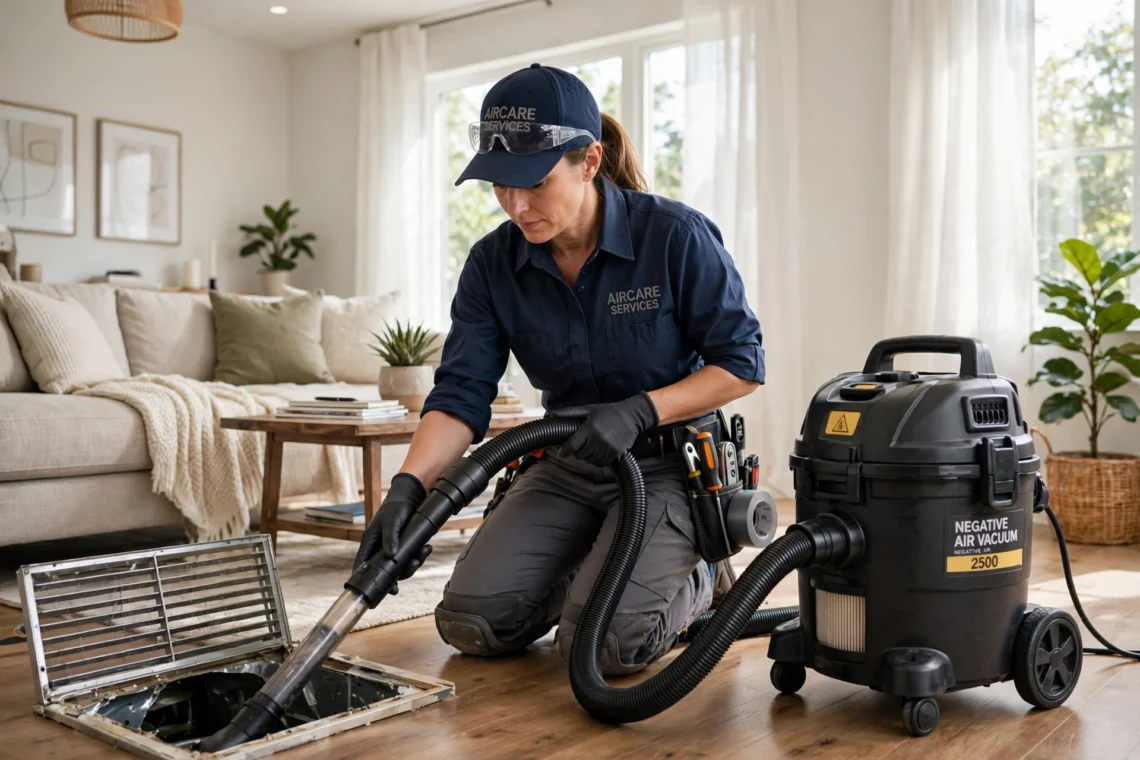
Professional duct cleaning generally involves loosening accumulated material and collecting it with suitable vacuum equipment. The exact method depends on the duct material, system design, and type of contamination.
The EPA recommends methods that control the release of dust and other particles into the home. This can include vacuum equipment that exhausts outdoors or suitable HEPA-filtered equipment when the exhaust remains indoors.
A contractor should explain how the cleaning process will protect the property and prevent dislodged debris from spreading into occupied rooms.
Ask whether the company uses appropriate agitation tools, controlled vacuum collection, and suitable access procedures. Flexible ducts and internally insulated ductwork may require different handling from sheet-metal ducts.
The provider should also explain how access openings will be sealed after cleaning and how the work will avoid damaging ductwork or insulation.
A large machine or an impressive equipment photograph does not prove that a company will clean the system thoroughly. What matters is whether the equipment and procedures are suitable for the particular installation.
5. Health Claims, Chemicals, and Realistic Expectations
Air duct cleaning can remove accumulated debris when contamination is present. However, the EPA notes that evidence is limited regarding whether cleaning ducts alone improves health symptoms or increases energy efficiency.
This is why guarantees such as eliminating all allergens, curing asthma, or permanently preventing mold should raise concerns.
Indoor air quality depends on more than duct cleanliness. Ventilation, filtration, indoor pollution sources, and moisture control also influence the air inside a home.
Chemical biocides, sanitizers, and sealants deserve particular scrutiny. These products are not automatically necessary for ordinary duct cleaning. Their suitability depends on the specific problem, the surfaces involved, and the product’s approved uses.
Before agreeing to an additional treatment, ask:
- What specific problem is the treatment intended to address?
- Why is mechanical cleaning alone insufficient?
- Which product will be used?
- Is it suitable for the duct material?
- What precautions are required during and after application?
- Is the treatment included in the original estimate or charged separately?
A responsible contractor should explain the benefits, limitations, and costs without pressuring you into approving an optional service.
6. Evaluate Reviews and References Carefully
Customer reviews can provide useful information about punctuality, communication, pricing, cleanliness, and how a company responds when problems occur.
However, reviews should be considered alongside credentials, written estimates, and the contractor’s proposed methods.
Look for consistent patterns across multiple reviews rather than relying on one highly positive or negative comment. Pay attention to whether customers mention clear explanations, respect for the property, unexpected charges, or difficulty resolving complaints.
For larger jobs, asking for references from previous customers with similar HVAC systems can provide additional context.
You can also compare the company’s stated service policies with its written quotation. If a provider advertises transparent pricing, ask it to explain exactly which circumstances could result in additional charges.
An established online presence is helpful, but it does not replace verifying qualifications, insurance, and the actual scope of work.
7. Boston Homes: Older Properties and Local Considerations
Boston includes a wide range of residential properties, from older homes with legacy ductwork to newer construction with modern HVAC systems.
These differences can affect access, cleaning methods, and the time required to complete a job. Older duct systems may also contain damaged insulation or other materials that require specialist assessment before work begins.
Before scheduling service, confirm that the company serves your neighborhood and has experience with your type of system.
Discuss any relevant property details, including:
- The approximate age of the home and HVAC equipment.
- The number of heating and cooling systems.
- Whether the ducts are metal, flexible, or internally insulated.
- Any recent renovations or construction.
- Previous water damage, pest activity, or suspected contamination.
- Access limitations in basements, attics, or mechanical spaces.
If a contractor suspects asbestos-containing materials in or around the duct system, those materials should not be disturbed during ordinary cleaning. Appropriate assessment and specialized procedures may be necessary.
A company that asks relevant questions before providing a quotation is better positioned to estimate the work accurately.
8. After the Job: Inspection and Documentation
The service should not end when the cleaning equipment is switched off. A professional provider should explain what was cleaned and how the results can be checked.
The EPA recommends a thorough visual inspection as an important way to assess cleanliness after the job. Some contractors can also provide photographs of accessible duct interiors before and after cleaning.
Ask whether the company will allow you to inspect the work and explain any components that could not be accessed.
A completion report may include the areas serviced, visible findings, photographs where available, and recommendations for repairs or further investigation.
Remember that photographs are supporting evidence, not an automatic guarantee that every part of the system has been cleaned properly. The documentation should correspond to the agreed scope of work.
If the contractor identifies damaged ductwork, persistent moisture, or another issue that cleaning cannot resolve, ask for a clear explanation and a separate estimate for any additional work.
9. Red Flags and Misleading Sales Practices
Unusually low prices and aggressive sales tactics can make it difficult to distinguish a genuine service from a misleading offer.
The EPA advises consumers to be wary of sweeping health claims, unsupported recommendations for routine cleaning, and providers who cannot give complete answers about their methods.
Warning signs include:
- An exceptionally low advertised price that changes substantially after arrival.
- Claims that every home requires immediate cleaning.
- Assertions that the EPA certifies or endorses the company.
- Pressure to purchase expensive chemical treatments without a clear explanation.
- Claims of mold contamination without showing the suspected problem.
- Refusal to provide a written estimate or explain additional charges.
- Requests to approve extensive repairs without supporting evidence.
If a contractor identifies an unexpected problem, take time to review the findings and obtain another opinion when appropriate. You do not need to approve unrelated work simply because a technician is already at your home.
A reliable provider should help you understand the available options and make an informed decision.
Frequently Asked Questions
How often should air ducts be cleaned?
There is no universal cleaning interval that applies to every home. The EPA recommends cleaning when specific conditions justify it, such as substantial contamination, pest infestation, or significant debris accumulation. Routine HVAC inspections and filter maintenance remain important even when duct cleaning is unnecessary.
Is NADCA certification required for every air duct cleaner?
NADCA membership and certification are useful indicators of industry training and standards, but consumers should verify the particular credentials held by the company and its personnel. Check applicable Massachusetts requirements for the work being performed.
How many estimates should I obtain?
The EPA recommends getting written estimates from at least three service providers. Compare the total price, cleaning scope, equipment, containment procedures, and any optional treatments rather than choosing on price alone.
Does air duct cleaning eliminate mold?
Cleaning may remove contamination from appropriate surfaces, but it does not resolve the moisture source that allowed mold to develop. Damaged porous materials may require replacement or specialist remediation. The correct response depends on the condition and material involved.
Should I choose the company with the lowest price?
Not necessarily. A low starting price may cover fewer components or exclude important work. A detailed estimate helps you determine which provider offers the most appropriate service for your system and budget.
Choose Mass Green Air Duct Cleaning for a More Informed Service Experience
Finding the right air duct cleaning provider starts with clear information, a proper assessment, and a written scope of work. Homeowners should understand why cleaning is recommended, which components will be addressed, what the service costs, and how the completed work will be checked.
For homeowners researching air duct cleaning company Boston options, Mass Green Air Duct Cleaning is a Massachusetts-based service provider that advertises air duct cleaning and inspection services for Boston and surrounding communities.
Before booking, discuss your property’s needs, request a written estimate, and confirm which services are included in the quoted price. Ask about the cleaning method, any proposed additional treatments, and the documentation available after the service.
Visit Mass Green Air Duct Cleaning to review the company’s services and request information about your home.
The best choice is a company that explains its recommendations, demonstrates the need for the work, and respects your right to make an informed decision. By evaluating credentials, methods, pricing, and verification procedures, you can approach air duct cleaning with greater confidence and avoid paying for services your home may not need.