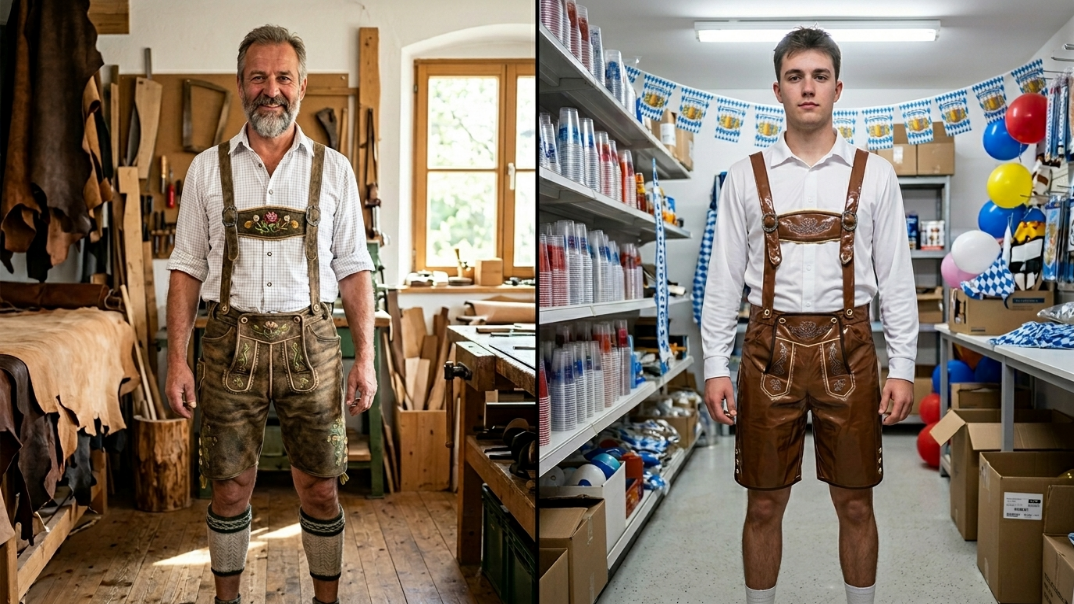
Search for lederhosen online and two completely different products appear under one name: genuine leather garments built in the Bavarian tradition, and party costumes styled to imitate them in photographs. Both call themselves lederhosen. Only one actually is. The difference decides everything that matters — how the garment looks in person, whether it survives a festival day, how it photographs up close, and whether it exists at all next season. This guide gives you the complete authentication toolkit: the five checks that expose any listing’s true tier in under a minute, an honest look at where the costume tier legitimately belongs, and the reasons real construction wins for anyone attending an actual event.
The Two Tiers, Defined
What Authentic Lederhosen Are
Authentic lederhosen are made from genuine hide — suede cowhide, goatskin or deerskin — with stitched embroidery, functional button-front construction, real suspender buttons, adjustable lacing, and finished interior seams. They are clothing in the full sense: sized by measurement, built to mold to the wearer, and engineered for years of festivals. Traditional lederhosen of this grade are what Bavarians themselves wear and hand down.
What a Lederhosen Costume Is
A lederhosen costume is a themed party product: vinyl or polyester “leather-look” fabric, printed-on decoration, elastic waistbands, sewn-shut fake flaps, and clip-on elastic straps imitating suspenders. It is manufactured for one or two wearings, priced accordingly, and sold through party and costume channels — often bundled as a complete outfit with a printed shirt.
The Five-Check Authentication Screen
Check Zero: Read the Listing Language First
Before the five formal checks, the listing’s own vocabulary often settles the question. Authentic sellers write like garment makers: they name hides, cite measurements in centimeters, describe tanning, mention break-in behavior and reference Trachten conventions. Costume sellers write like party suppliers: “one size fits most,” “complete outfit set,” “perfect for Halloween and theme parties,” “easy care machine washable” — that last phrase being an outright confession, since genuine leather is never machine washable. Neither vocabulary is accidental; each describes the product behind it accurately. Train your eye on the language and half of all listings classify themselves before a single photograph is examined.
Check One: The Material Line
The fastest test in the category. Real lederhosen listings name their hide — “suede cowhide,” “goatskin,” “deerskin leather.” Costume listings hide behind “faux leather,” “PU,” “leather-look,” or say nothing at all. Real lederhosen cannot be made without real leather, so an unnamed material is an answered question.
Check Two: Embroidery Dimension
Zoom into the front flap. Authentic embroidery is stitched thread with visible texture and dimension — you could feel it. Costume decoration is printed flat onto the fabric surface, and magnification exposes it instantly. This single zoom defeats most imitation listings.
Check Three: Construction Details
Real lederhosen show their engineering: working button-front flaps, side or back lacing, sewn suspender buttons, bound seams and finished edges. Costumes substitute elastic waists, decorative non-functional flaps, and raw-cut edges. Any two of these tells together are conclusive.
Check Four: The Price Floor
Genuine leather has a raw-material cost no maker can dodge, which sets a structural price floor — real lederhosen begin around the level quality hide demands and rise with the leather grade. The costume tier lives far below that floor, because vinyl economics allow it. A price dramatically under the floor is a guarantee, not a bargain.
Check Five: Sizing System
Authentic pairs sell by body measurements against a published size chart, because leather garments are patterned precisely. Costumes sell in S/M/L with “stretch fit” as a feature — the elastic waistband announcing itself. The presence or absence of a measurement chart quietly reveals everything about what’s behind the photos.
Where the Costume Tier Honestly Belongs
Fairness requires saying it plainly: the costume tier is not a scam when bought knowingly. Anyone shopping to buy german lederhosen costume products for a single fancy-dress party, a themed office event, or a one-night Halloween outfit is buying a product whose honest price matches its honest lifespan. Lederhosen costumes exist for exactly those occasions, and they serve them adequately.
The problem — and the source of nearly every disappointed review in the category — is the mismatch: costume-tier products marketed with authentic language to buyers planning real festival attendance, repeat wear, and photographs that matter. At an actual Oktoberfest, surrounded by real leather, the vinyl tier is visible across a beer tent, uncomfortable within an hour, and frequently split-seamed by the evening. The five checks exist to prevent exactly that purchase.
Why Real Wins for Real Events
For anyone attending an actual festival even once a year, authentic german lederhosen construction wins on every axis that matters. Appearance: genuine suede reads matte, deep and textured in person and in photos; vinyl shines artificially under tent lighting. Comfort: leather breathes and molds through a twelve-hour day; synthetics trap heat and chafe. Durability: real lederhosen serve five, ten, twenty years and improve with age; costumes rarely survive a second season. Economics: the cost-per-wear of an authentic pair passes the costume tier within about two seasons of genuine use — and keeps falling every year after, while the costume habit resets to zero annually.
The verdict experienced wearers reach is unanimous: buy the costume tier only for costume occasions, and buy real lederhosen for everything else.
The Printable Authentication Checklist
Condensed for use at the moment of purchase, here is the complete screen in order of speed. Language check: maker vocabulary versus party vocabulary. Material line: a named genuine hide — suede cowhide, goatskin, deerskin — or an automatic fail on “PU,” “faux” and silence. Embroidery zoom: stitched dimension versus flat printing on the front flap close-up. Construction scan: working button flap, side or rear lacing, sewn suspender buttons, bound seams. Price floor: at or above genuine-leather economics, with dramatic undercuts read as verdicts. Sizing system: measurement chart present versus S/M/L stretch sizing.
Run all six on any listing and the classification takes under two minutes, with no ambiguous outcomes: authentic pairs pass everything, costumes fail almost everything, and the rare mixed result — real leather with weak construction, say — identifies the low end of the authentic tier, priced accordingly. The checklist also works in reverse as a shopping filter: search only among listings that name their hide and publish measurement charts, and the costume tier disappears from view before it can waste a minute of comparison.
Price vs Value: Thinking in Cost-Per-Wear
The tier decision clarifies completely once the arithmetic switches from price to cost-per-wear. A costume-tier purchase looks cheap at checkout and expensive ever after: one or two wearings before failure puts its true cost per festival day at nearly the full sticker — repeated every season the habit continues. An authentic pair inverts the math: a higher entry price divided across the five, ten or twenty years genuine leather serves drives the per-wear figure below the costume tier within roughly two seasons of real use, then keeps falling every year after — while the garment itself improves, molds and gains the patina the tradition prizes. The comparison isn’t close, and it isn’t only financial: the authentic pair also delivers every wearing at full quality (comfort, photographs, credibility), where the costume delivers its best wearing first and declines from there. Buyers planning any repeat festival attendance are choosing between a recurring cost and a depreciating-then-appreciating asset; the checks in this guide simply make sure the asset is real.
Frequently Asked Questions
What is the fastest way to spot fake lederhosen?
The material line: genuine hide named explicitly passes; “faux leather,” “PU” or silence fails. It takes five seconds and settles most listings.
Can printed embroidery really be seen in photos?
Yes — zooming into the front flap exposes flat printing against the dimension of real stitched threadwork immediately.
Is a lederhosen costume ever the right purchase?
For a knowing one-night fancy-dress occasion, yes. The failure is only ever the mismatch: costume-tier products bought for real festival plans.
Why are real lederhosen more expensive?
Genuine leather’s raw-material cost sets a structural price floor, and pattern-cut construction, stitched embroidery and real hardware add labor no vinyl shell requires.
Do authentic lederhosen actually save money?
Over time, decisively — cost-per-wear passes the costume tier within roughly two seasons of real use, and an authentic pair keeps serving for many years after.
What does PU leather mean on a lederhosen listing?
Polyurethane — a plastic coating on fabric backing. It is the costume tier’s standard material and disqualifies a listing from the authentic category instantly.
Do real lederhosen smell different from fake ones?
Distinctly — genuine leather carries its natural hide scent, while vinyl and PU arrive with a chemical odor that reviews of costume-tier products mention constantly.
The Bottom Line
Authentic lederhosen and lederhosen costumes are two different products sharing one word, and the five-check screen — material, embroidery, construction, price floor, sizing — separates them in under a minute on any listing. Match the tier to the occasion honestly: costumes for costume nights, real lederhosen for every real festival. Your photographs, your comfort at hour ten, and your wardrobe five years from now will all confirm you checked.
Read More: sistrology.org