Electronic waste is often treated as a disposal problem, but by the time unwanted equipment reaches a storeroom or recycling container, many of the most important decisions have already been made. Product design, supplier selection, contract terms, repairability, and upgrade policies all influence whether a device will remain useful for years or become waste after a relatively minor failure.
That makes procurement one of the strongest—and most frequently overlooked—tools for preventing electronic waste. Buyers do not need to be engineers or recycling specialists to make a measurable difference. They need a purchasing framework that considers the complete life cycle of every device, from initial demand to repair, reuse, resale, material recovery, and documented end-of-life processing.
Begin With the Business Need, Not the Product List
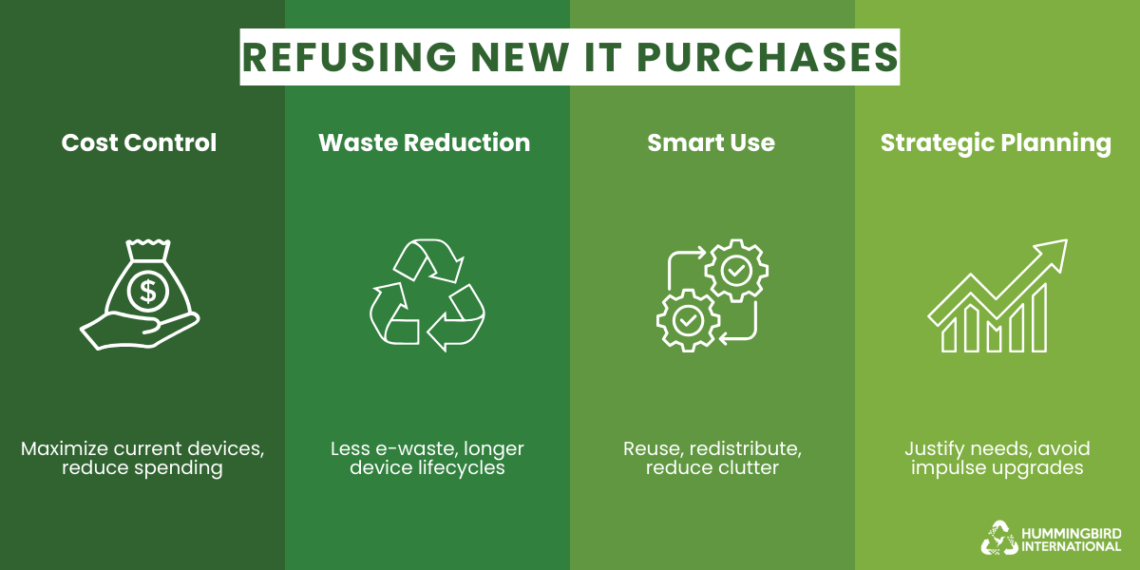
Waste prevention starts before a request for quotation is issued. Procurement teams should challenge the assumption that every operational need requires a new device. A department requesting 50 new laptops may actually need additional computing capacity, better battery performance, or replacements for only a portion of its existing fleet.
Before approving a purchase, ask:
- Can current equipment be repaired, upgraded, or reassigned?
- Could devices from another department satisfy the requirement?
- Is leasing or device-as-a-service more appropriate than ownership?
- Are requested specifications based on real workloads or simply the newest available model?
- Can standardized accessories reduce the need for new chargers, cables, and adapters?
This demand-review step can eliminate unnecessary purchases while reducing capital expenditure. It also prevents functional electronics from being replaced simply because budgets, habits, or fragmented asset records make buying easier than reusing.
Evaluate Total Cost of Ownership
The lowest purchase price rarely represents the lowest long-term cost. A less expensive device may have a sealed battery, limited software support, proprietary components, or no practical repair pathway. When it fails, the organization pays again through downtime, replacement, data handling, storage, and disposal.
A stronger evaluation model includes expected service life, energy consumption, warranty coverage, repair costs, spare-part availability, upgrade options, resale potential, and end-of-life processing. Buyers can assign weighted scores to these factors alongside price and performance.
For example, a laptop that costs 10 percent more but supports memory upgrades, battery replacement, and five years of security updates may deliver far greater value than a cheaper model designed for limited servicing. The same principle applies to servers, telecommunications equipment, industrial controls, office electronics, and specialized machinery.
Put Repairability Into the Specification
General promises about durability are difficult to enforce. Procurement documents should instead request evidence that products can be maintained. Useful criteria include replaceable batteries, accessible fasteners, modular components, diagnostic tools, repair manuals, and guaranteed spare-part availability for a defined period.
Buyers should also examine the design of the printed circuit board (elektroplate) and other high-value assemblies. When major functions are integrated into one non-serviceable unit, a single fault can make an entire product uneconomical to repair. Modular assemblies may allow technicians to replace only the failed component, extending equipment life and reducing both material use and downtime.
Contracts can strengthen these expectations by establishing target repair times, maximum service charges, and procedures for warranty claims. Suppliers should explain whether authorized repair is available locally and whether independent technicians can obtain parts and technical information.
Standardize Without Creating Lock-In
Standardization can prevent waste when it allows equipment, components, and accessories to be shared. Common charging standards, interchangeable batteries, consistent docking systems, and compatible replacement parts make devices easier to redeploy and maintain.
However, standardization should not become dependence on a closed ecosystem. A supplier that uses proprietary connectors or restricts access to software and spare parts can create expensive barriers to repair. Procurement teams should favor interoperable products and open data formats while including exit provisions in long-term agreements.
A practical standardization policy might limit the number of approved device families while requiring compatibility with widely available peripherals. This simplifies training and inventory without surrendering flexibility.
Ask Suppliers the Right Circularity Questions
Sustainability claims are most useful when they are specific and verifiable. Instead of asking whether a product is environmentally friendly, request information that can be compared across bids.
Questions worth including in supplier assessments
- How long will operating-system and security updates be provided?
- What percentage of the product contains recycled material?
- Which components can be replaced without specialist equipment?
- For how many years will spare parts remain available?
- Does the supplier provide repair, refurbishment, or take-back services?
- How are returned devices tested, reused, dismantled, and recycled?
- Can the supplier provide records showing where recovered materials go?
- Is packaging reusable, recyclable, or returnable?
Answers should become part of the contract rather than remaining in a sales presentation. Measurable commitments give contract managers a basis for reviewing performance and help discourage vague environmental marketing.
Plan the Next Use Before Delivery
Every device should enter the organization with an expected service life and an exit route. Asset tags, serial-number records, assigned users, warranty dates, repair histories, and data-security requirements should be captured as soon as equipment is received.
When a device no longer meets the needs of one team, a clear hierarchy can guide the next decision: maintain it, upgrade it, redeploy it, refurbish it, resell or donate it, recover usable parts, and recycle the remaining materials. Disposal should be the final option, not the default response to obsolescence.
Data security must be built into this process. Organizations sometimes retain outdated electronics for years because no one is authorized to erase or destroy stored information. A documented sanitization procedure enables responsible reuse while reducing the cost and risk of unmanaged stockpiles.
Build a Responsible Recovery Partnership
Even well-designed procurement programs eventually produce electronic waste (elektronikas atkritumi). Batteries degrade, technologies change, and some equipment becomes physically damaged beyond repair. At that point, the quality of the recovery partner matters.
Organizations should look for transparent evaluation, reliable documentation, secure handling, and the ability to identify material value accurately. Metalbee brings this recovery perspective to electronic materials, including printed circuit boards and non-ferrous metals. Its emphasis on laboratory-supported assessment, professional transactions, and responsible recycling can help businesses move recoverable materials out of storage and into a properly managed value chain.
A recycler can also provide useful feedback to procurement. Recurring issues—such as products that are difficult to dismantle, mixed materials that reduce recovery value, or components that retain strong secondary-market demand—can inform future specifications. This creates a practical feedback loop between purchasing and end-of-life management.
Measure Prevention, Not Just Recycling
Recycling volume alone is an incomplete sustainability metric. If an organization reports more recycled electronics every year, it may be recovering materials responsibly—or simply replacing equipment too quickly.
More informative indicators include average device life, repair rate, percentage of assets redeployed, number of purchases avoided through reuse, spare-part availability, residual resale value, supplier take-back performance, and the share of retired equipment with a documented destination. Procurement can review these measures quarterly and use the findings in supplier evaluations and future tenders.
Set a realistic baseline, choose two or three indicators, and improve the process before expanding the dashboard. Even a simple target—such as extending the average laptop replacement cycle or increasing internal redeployment—can translate into lower costs and fewer discarded devices.
Turn Procurement Into a Waste-Prevention Strategy
Reducing electronic waste does not require one perfect purchasing decision. It requires consistent choices that reward durable design, repair access, interoperability, responsible suppliers, and credible recovery routes.
Start with one high-volume category and review its full journey through the organization. Update the specification, establish life-cycle scoring, clarify repair responsibilities, and define what happens when assets are retired. At the same time, speak with an experienced recovery specialist such as Metalbee about the electronic materials already accumulating in storage. Combining better purchasing with professional end-of-life management allows organizations to reduce waste before it starts—and recover value responsibly when prevention is no longer possible.