The objective evaluation of human facial aesthetics has transitioned from a subjective cultural guessing game into a repeatable, data-driven computational practice. Historically, evaluating facial traits relied on standard artistic observations, manual physical measurements, or crowdsourced consumer opinions. Modern machine learning models execute these complex structural checks by running computer vision scanning configurations over flat image uploads. This mathematical development lets digital design branches, skincare analysts, and portrait photographers check facial proportions, symmetry indices, and textural features instantly.
The Technical Framework of Algorithmic Facial Mapping
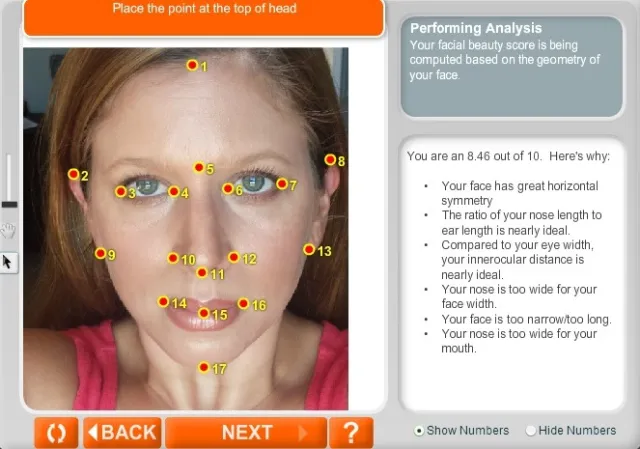
To compute a concrete aesthetic baseline rating from a single photograph, modern analysis engines deploy deep convolutional neural networks combined with specialized facial landmark tracking systems. When a user uploads a profile picture, the underlying program identifies the precise spatial coordinates of standard anatomical anchors. The model maps dozens of distinct structural vectors, locking down key borders around the jawline contour, the alignment of the eyelids, the width of the nose bridge, and the curvature of the mouth.
Following this initial vector alignment, the software runs structural comparative checks using historical artistic constraints like the Golden Ratio (phi) framework. It evaluates the relational distance between the eyes against total facial width and measures the vertical division of the forehead, nose, and chin segments. These geometric calculations verify facial symmetry indices, helping users see how closely their physical proportions match standard mathematical balance metrics across every quadrant of the canvas.
Creative Applications and Digital Transformation Workflows
The practical utility of deep portrait analysis extends far beyond casual entertainment or curiosity tests on social channels. Professional portrait photographers and digital illustrators use automated proportion scanning to fine-tune canvas compositions, adjust camera focal parameters, and correct unnatural lens barrel distortions in editing suites. Verifying feature positioning rapidly ensures that digital artwork retains proper human anatomy rules before final portfolio delivery.
For marketing teams and product developers, deploying an automated testing sequence via a dedicated how attractive am i AI collection workspace provides valuable insights for consumer campaigns. Modeling agencies and virtual try-on software tools integrate structural facial analysis pipelines to match clothing textures, eyeglass frame geometries, and cosmetic palettes to distinct face shapes automatically. This direct personalization system lowers product return rates while improving audience conversion metrics on digital interfaces.
Optimizing Initial Reference Media for Coherent Analysis
The ultimate fidelity and precision of an automated facial calculation rely heavily on the visual conditions of your initial image asset. Uploading low-resolution, blurry, or heavily compressed reference pictures with visible sensor grain triggers algorithmic processing faults, as the network struggles to separate actual anatomical borders from pixel artifacts. High-contrast source photographs featuring flat lighting setups provide the best mathematical canvas for clean landmark tracking.
Camera orientation angles and resting expressions also determine score consistency. Submitting portraits with a dramatic side tilt, harsh three-quarter angles, or extreme emotional expressions like wide smiles warps the structural distance matrices, leading to inaccurate geometric calculations. Maintaining a straight, front-facing camera angle with neutral expressions mimics professional biometric scanning parameters, preserving initial face tracking values across all quadrants seamlessly.
Infrastructure Pathways and Data Protection Safeguards
Deciding between server-side cloud execution networks or deploying localized browser-based processing scripts involves checking immediate hardware limitations and strict database confidentiality targets. Remote server clusters handle complex deep learning calculations instantly, allowing users to process multi-layered facial evaluations from basic smartphones or portable tablets without local hardware lag. Conversely, executing tasks inside local browser memory channels ensures absolute data protection, as raw face matrices stay locked on your personal device drive rather than migrating to external corporate databases.
As computer vision frameworks continue to evolve, automated aesthetic modeling suites will deliver intricate dermal texturing scans alongside core geometric proportion scoring. By analyzing specific input parameters and utilizing flexible, high-resolution checking tools, contemporary design workers can successfully incorporate automated portrait evaluation into their regular workflows today.