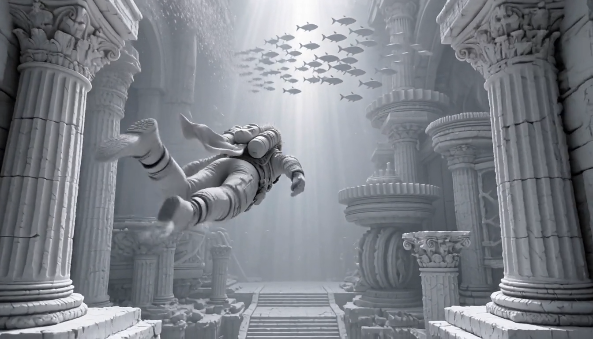
From individual images to continuous visual relationships, generative media is evolving from singular images to continuous spaces. The goal of new world-model concepts is to model spaces, objects, viewpoints, and relations simultaneously. A ByteDance concept is not an actual consumer product; rather, it is a future path. Meanwhile, Pippit can be used for visual storytelling, scene planning, and production direction. The bigger change is about spatial intelligence, not just higher or more realistic resolution images.
From Single Images to Connected Environments
Generative systems are evolving from single output to connected scene structures. While an AI video generator can help bring imagery to life, continuity requires scene representation. The thing that changes is that it’s a world you’re representing and not enhancing one frame. Pippit links scripts, characters, scenes, sound, and visual direction.
| Generation Approach | Primary Output | Main Limitation |
| Text-to-image | One visual frame | Limited spatial continuity |
| Image-to-video | Moving sequence | Scene relationships can remain constrained |
| 3D asset generation | Individual object | Does not automatically create a complete world |
| 3D world modeling | Connected environment | Enables spatial relationships and multiple viewpoints |
Relationships between views can be maintained in a connected environment. Resolution is not the only thing that is important for world-level representation.
What Makes a 3D World Model Different
Seeworld presents an approach for ByteDance’s next 3D world-model project. Characteristics reported include game-like navigation, scene-level spatial understanding, layout control, and multiple viewpoints. Object relationships and reference-guided generation for connected environments are also included in the concept. A world model can be used to structure characters, objects, architecture, and camera perspectives in one spatial structure. These characteristics are derived from reported reference data, and not from a published consumer interface. It would be premature to consider them proven product features.
Why Spatial Relationships Matter More Than Visual Realism Alone
Visual realism does not necessarily clarify the relationship of elements to each other’s environment. A good picture can still hide distance, scale, depth, or camera position. Spatial modeling is about relationships between objects, characters, architecture, and surrounding boundaries. The foreground and background can alter the viewer’s perception of importance and movement. Relative scale can indicate an object’s proximity or distance from the viewer across a room. There are different ways that the camera can be positioned so that different relationships will be visible from different perspectives. Those relationships are maintained with environmental continuity when there is a change in perspective. These factors can help with intentional writing. Spatial orientation is important if it is a scene that needs to be explored, revised, or retaken.
Steps to See World Shows Why 3D World Models Are the Next Big Shift.
Step 1: Frame the World-Model Story
- Sign up for Pippit using Google, TikTok, or Facebook account information before exploring world-model concepts.
- Open the “Story Studio” tab from the left menu on the home page to access tools.
- Upload your script through “Upload script”, or write or paste it using “Paste script”.
- Use “AI scriptwriter” from the top menu to explain differences between world models and image generators.
- Choose an approach through “Style library” at the bottom left of the dialogue box for an explanatory concept.
- Select “Default ratio” for your preferred aspect ratio, then choose episodes through the “Episodes” tab.
- Click “Generate” finally, allowing AI to generate your structured technology script for review right now.
Step 2: Build Comparative Visualization Assets
- Add images, scene videos, audio, and characters through the “Creative Canvas” tab to maintain control throughout.
- Write prompts for every section, specifying environments, spatial context, camera angles, styles, lighting, and examples.
- After assigning roles, generating characters, and creating scenes, click “Batch generate” to produce episodes efficiently.
Step 3: Review the Technology Narrative
- Review and edit characters, roles, scenes, audio, and explanations carefully before publishing your world-model overview.
- If satisfied, click “Select all”, then “Download” to bulk download episodes onto your device directly.
The Three Layers of the Emerging Spatial-AI Workflow
To understand the usefulness of a spatial-AI workflow, it is important to see three layers that are interconnected:
- World: The setting is identified by the environment, architecture, objects, boundaries, and spatial relationships.
- Direction: How the setting is represented through camera position, framing, movement, scale, and composition.
- Story: The scene is filled with purpose through narration, pacing, actions, product context, and communication.
Pippit is particularly suited for the story and production layer in this model. It is a workflow that links scripts to characters, scenes, sounds, and images. Production tools can shape the audience’s experience of the world, and spatial systems can define the world. Preserving these layers can help make creative decisions in the early planning process. It can be used to determine if the problem is an environment problem, direction problem, or storytelling problem.
Where 3D World Models Could Change Pre-Production
The 3D world-model workflow might impact architecture visualization, game environments, and film previsualization. Product ideas could be tried out within stable environments prior to the creation of full ads. It might be possible to use spatial scenes in product launches to explore scale, position, lighting, and camera relationships. Early exploration of layouts and environmental structure could be valuable for virtual spaces. Interior planning might be able to test layouts prior to doing any visualization work. Storyboarding potentially could be more spatial as creators experiment with camera locations within linked environments. Structured spaces might also be used in educational simulations to show processes, location, or interactions. These are still potential workflow uses, not any system guarantees.
Why Reference-Guided Generation Changes the Starting Point
With the help of reference-guided generation, creators can start detailed scene construction with a visual anchor. A reference can set up an environment style, object appearance, architectural direction, or compositional intent. This can decrease ambiguity when it comes to describing all the visual information from a blank prompt. It provides guidance to creators in the areas of scale, mood, and spatial arrangement. A reference does not necessarily imply correct geometry or continuity of the scenes. Human oversight remains important if relationships, proportions, or brand details call for precision. Pippit can support this by structuring the visual storytelling in specified scenes and production requirements. This helps to make communication from concept to production clearer.
Conclusion
3D models of the world are not just for creating more impressive graphics. They have potential applications in the representation of space, relationships, viewpoint, and connected environment in AI. This transition transforms the creative task from picture-making into space-building and space-exploring. Pippit today provides the practical connection between spatial ideas and structured visual narratives. Spatial intelligence might turn into a significant layer of generative media as world-model research evolves. Powerful workflows can involve world-building, camera direction, storytelling, and human review. This can help to plan, communicate, and develop more complex visual ideas.